
Group stage plus knockout is the club-open default for a reason. Everyone gets a few real matches. Then a bracket, so the day actually ends with a champion.
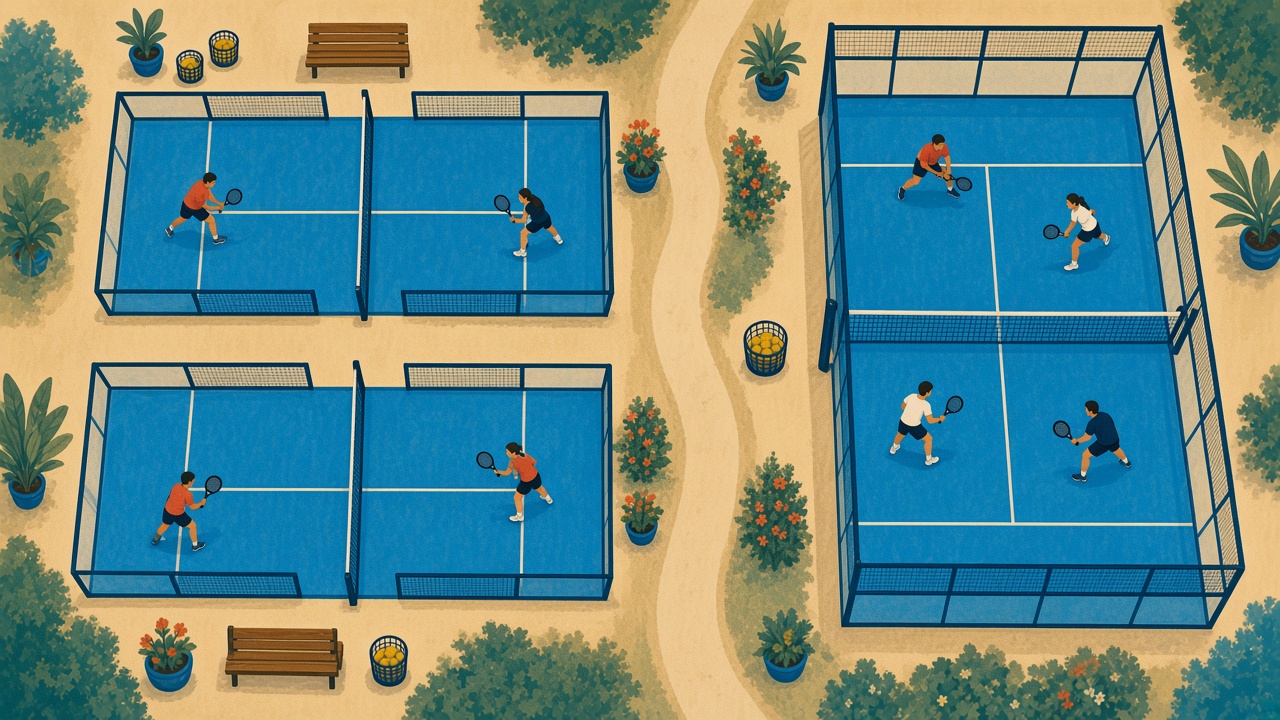
The small courts are the groups. The big one is what those groups are playing for.
A round robin is one group, and the table is the result. This format is several small round robins, and only the top of each table goes through. A qualification draw is different again: some pairs skip the first phase entirely. Here, everybody plays the groups. That is the point.
Matches first, then a bracket
Fixed pairs. Split into groups. Each group plays its own round robin. The top two — sometimes only the winner, sometimes three — move into an elimination bracket. Lose in the groups and you can still go through. Lose in the bracket and you are out.
Eight pairs in one round robin is 28 matches. The same eight pairs in two four-pair groups, top two through, is 12 group matches plus two semis plus a final. Fifteen matches, and you still get a final. That is the whole argument for this draw.
Groups are how you keep a knockout from being cruel, and a knockout is how you keep groups from lasting until Monday.
A worked draw: two four-pair groups
Eight pairs. Group A and Group B, four pairs each. In each group, every pair plays the other three: three rounds, two matches a round, so a group can run on two courts without anyone sitting.
Group A
| Round | Match | Result |
|---|---|---|
| 1 | Ana & Ben vs Gia & Hugo | Ana & Ben, 6–3, 6–2 |
| 1 | Carla & Dani vs Eva & Finn | Carla & Dani, 6–4, 6–4 |
| 2 | Ana & Ben vs Eva & Finn | Ana & Ben, 6–2, 6–3 |
| 2 | Gia & Hugo vs Carla & Dani | Carla & Dani, 7–5, 6–4 |
| 3 | Ana & Ben vs Carla & Dani | Ana & Ben, 6–4, 3–6, 10–7 |
| 3 | Eva & Finn vs Gia & Hugo | Eva & Finn, 6–2, 6–3 |
| Pair | W | L |
|---|---|---|
| Ana & Ben | 3 | 0 |
| Carla & Dani | 2 | 1 |
| Eva & Finn | 1 | 2 |
| Gia & Hugo | 0 | 3 |
| Pair | W | L |
|---|---|---|
| Ines & Jules | 3 | 0 |
| Kim & Leo | 2 | 1 |
| Mia & Noor | 1 | 2 |
| Omar & Pia | 0 | 3 |
Group B is the same shape, so the afternoon has a mirror. Ines & Jules won all three. Kim & Leo beat Mia & Noor and Omar & Pia, and lost to Ines & Jules. Mia & Noor beat Omar & Pia and lost the other two. Omar & Pia went home without a win, but they played three matches. That is the promise you made when you picked groups instead of a straight knockout.
Who goes through has to be decided before round one. In this draw it is the top two. Eva & Finn and Mia & Noor each won a match and still missed the semis. If your flyer said “everyone plays a knockout,” you have a problem. If it said “top two,” you have a result.
Two four-pair groups is the one to learn first. Three four-pair groups gives you twelve pairs and an awkward six qualifiers — play two matches to cut them to four, or take the top two and accept that two group winners have to play each other before the semis. Four four-pair groups is a proper open: winners and runners-up fill an 8-pair quarter-final.
The crossover, which is the bit people get wrong
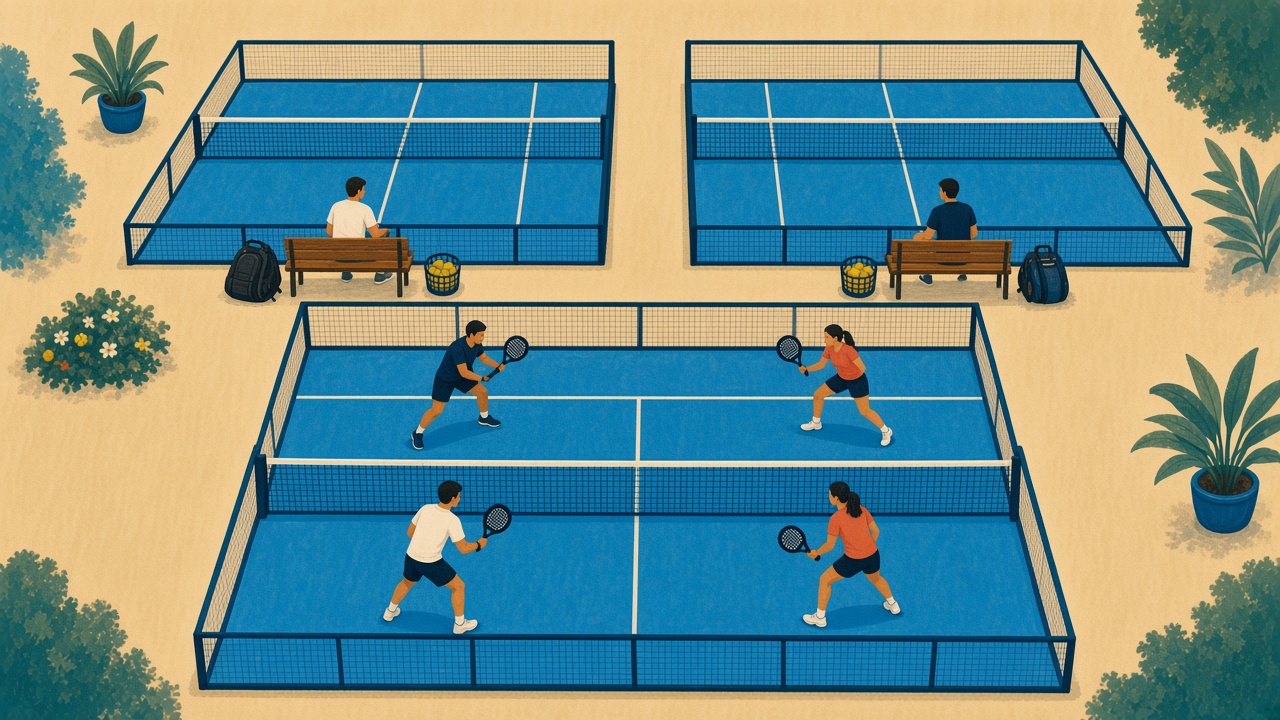
Groups finish. The pairs who went through walk onto the court that is still live.
First place in A plays second place in B. First in B plays second in A. The two group winners cannot meet until the final. If you pair A1 with B1 in the semi, you have spent the groups finding the two best pairs and then thrown them at each other one round early.
Semis and final · top two from each group
Ana & Ben won Group A and then won the tournament. Ines & Jules did everything asked of Group B and lost the final. Carla & Dani and Kim & Leo got a semi. The bottom two in each group played three times and stopped. Write that shape on the poster. It is a kinder day than a straight knockout, and it is still an elimination once the bracket starts.
Third and fourth do not get a secret second life unless you add a consolation and say so. A bronze match between the semi-final losers is optional, and it is the first match to delete when lunch ran long.
Who finishes second, when two pairs are level
Same rules as a round robin, and they matter more here, because second place is a semi-final and third place is the car park.
-
1
Matches won
In the example, the groups separated themselves. You will not always be that lucky.
-
2
Head-to-head
If Carla & Dani and Eva & Finn had both finished on two wins, their own match would decide second. Carla & Dani won it. They would go through.
-
3
Set difference, then game difference
Use these when three pairs are locked and the head-to-head is a circle. Put the order on the entry form. “Fair” is not a tie-break. It is what both pairs will claim they are owed.
If the last match in the group can be arranged — both pairs already through, or both already out — say what you do. Play it. A cancelled dead rubber sounds efficient until the pair who wanted the games asks for a refund in the car park.
When this is the draw
Use it
- The Saturday club open
- Any field big enough that a full round robin will not fit
- You want a champion, and you also want people to play before noon
- Leagues that finish with a final weekend
Skip it
- You have two hours. Play a straight knockout or an Americano
- Four pairs. That is just a round robin. Do not invent groups of two
- A social mixer. Pairs never change in this format
- You cannot explain “top two” in one message. Then you cannot run it
Seed the groups if you know the field: the two strongest pairs go in different groups, then the next two, so Group A is not the final before the final. If you draw groups out of a hat, say you drew them out of a hat.
The other draws
Same club, different Saturday.
The groups and the bracket should be the same sheet
Padel Playground runs the group tables, applies the tie-break you set, and builds the crossover knockout from whoever actually finished top. Players follow one link from the first group match to the final.
How many pairs go through?
Top two from a four-pair group is the usual club rule. Taking only the winner makes the group a long way to earn one match. Taking three from a four-pair group means almost everyone survives, and the knockout has to absorb a strange number. Decide before entries open.
What if a group has five pairs?
Each pair plays four matches, and one pair sits out each round. It works, and it is slower than a four-pair group. Prefer three-pair or four-pair groups. A three-pair group is three matches total — short, clear, and fine when the field will not divide into fours.
Do group results carry into the knockout?
No. The knockout starts at 0–0. Carrying games forward sounds fair and becomes a court case. The group’s only job is to decide who advances, and in what order.