
Qualification plus knockout is a cut, then a tournament. Some pairs are already in the main draw. Everyone else plays a preliminary round, and only the winners join them.

Qualifying is the court before the arch. The main draw is the courts on the other side.
This is not a group stage. In groups, every pair plays the first phase, and a table decides who goes through. In qualification, the direct entries do not play it at all. It is also not a bye inside a straight knockout. A bye is an empty slot in one bracket. Qualification is its own round, often its own session, and the main draw is what comes after the cut.
A door, and then a bracket
You decide the size of the main draw first. Eight is the usual club number. Sixteen if you have the courts. Then you count direct entries — pairs who skip qualifying — and everyone else.
The number that matters on the poster is how many teams can qualify. That is main-draw size minus direct entries. An eight-pair main draw with four direct entries leaves four qualifying spots. Only four teams from the qualifying pool will join the main draw. Everyone else in that pool is playing for one of those four places, not for “a spot somewhere.”
The arithmetic is simple. Qualifying spots = main draw − direct entries. Teams in qualifying = total entries − direct entries. When the quali pool is exactly twice the number of spots — eight teams for four spots — each team plays one match and the winners take the spots. When more teams want those same spots, qualifying becomes its own small knockout: same tree logic as the main draw, still ending when you have exactly enough winners.
Qualification is how a field that does not fit the day still gets a proper bracket, without pretending the extra pairs were byes.
One qualifying round: four spots, eight teams
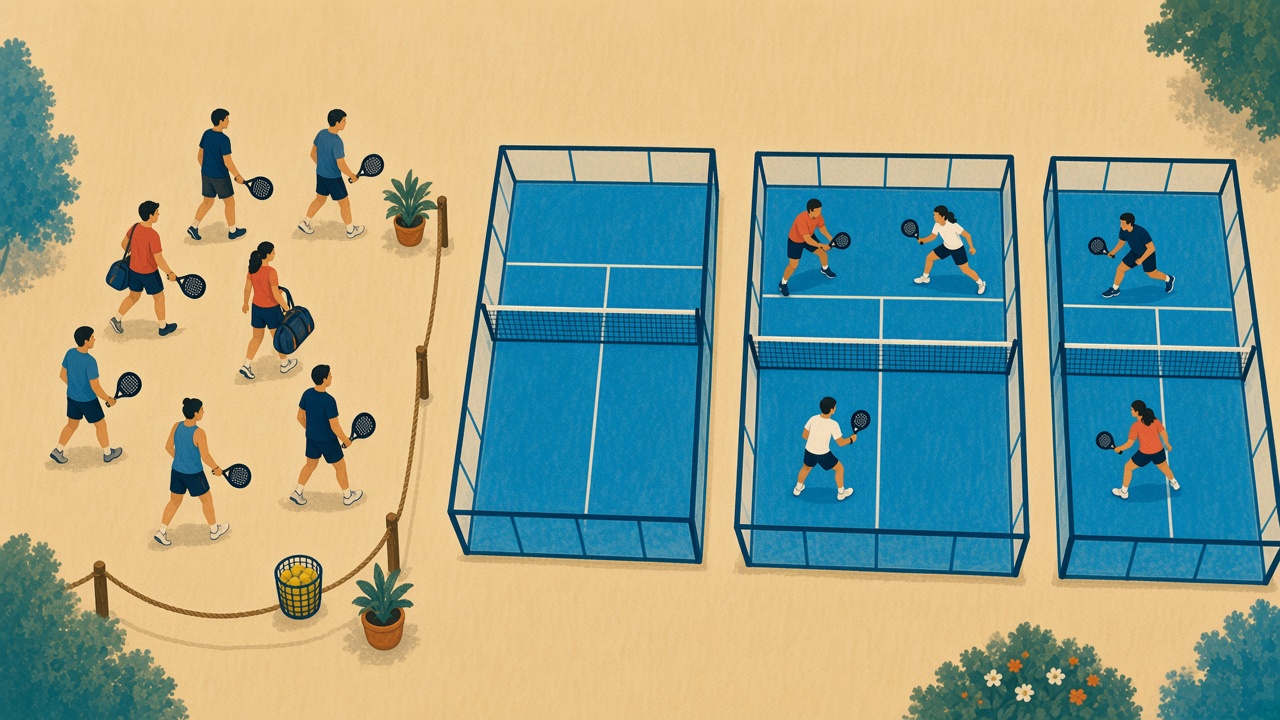
Same entry list. Two different afternoons. The rope is the part you have to explain before they pay.
Twelve pairs enter. The main draw holds eight. Four are direct — last year’s finalists, the top of your box league, or whoever you seeded and were willing to say out loud. That leaves four qualifying spots and eight teams in the qualifying pool. One match each: four winners qualify, four go home.
One set, or a pro set, is enough for that round. The main draw can still be best of three. Say both formats on the sheet. Players accept a short qualifier. They do not accept discovering it at 9:10.
Kim & Leo, Omar & Pia, Sam & Tess, and Will & Xio are out. They played once for one of four spots. That is what they signed up for, if you wrote “four teams qualify” on the entry form. If you did not, it is what they will argue about.
You can run this on Friday night and the main draw on Saturday. That is the grown-up version: the people who lost can still come and watch, and Saturday starts with eight pairs who are actually in.
When qualifying needs its own bracket
Same four qualifying spots into an eight-pair main draw. Same four direct entries. This time twelve teams are in the qualifying pool, all fighting for those four places. One round with six matches would leave six winners — two too many. You run a qualifying knockout: a mini bracket that ends when exactly four teams remain.
Give the four strongest quali seeds a bye into the second qualifying round — the same idea as byes in the main draw, but only inside qualifying. The other eight play round one. Round two is four matches. Four teams qualify. Everyone else in the pool is out.
Ines & Jules, Mia & Noor, Quinn & Rosa, and Uma & Vic are those four quali seeds. They wait while Kim & Leo, Omar & Pia, Sam & Tess, Will & Xio, Lea & Max, Jon & Kay, Ren & Sol, and Ty & Val play round one.
Qualifying draw · 4 teams qualify · 12 teams entered · 2 rounds
Ines & Jules, Mia & Noor, Quinn & Rosa, and Uma & Vic are the four that qualify. Lea & Max, Jon & Kay, Ren & Sol, and Ty & Val are out after round one. Will & Xio, Sam & Tess, Omar & Pia, and Kim & Leo won round one and still lost round two — that is the deal when twelve teams chase four spots.
Publish this qualifying tree before anyone hits a ball. Round one and round two are both part of the same cut. Do not “add a playoff” because two pairs looked evenly matched unless you said so upfront. Sixteen teams for four spots is the same pattern again: round one with eight matches, round two with four, stop when four names remain. The main draw still starts at quarter-finals. Only the path to get there got longer.
Four quali spots and eight quali teams → four matches, one round. Four quali spots and twelve quali teams → eight matches, two rounds. Four quali spots and sixteen quali teams → twelve matches, two rounds. Say the number of teams that can qualify and how many matches the rest might play.
Where the winners land in the main draw
The main draw is a normal eight-pair knockout. The only extra rule is where the qualifiers stand, so two direct entries do not meet in the first round, and the strongest direct does not play the strongest survivor of qualifying if you can help it.
A simple placement: seed 1 plays the last qualifier, seed 4 plays the first qualifier, seed 2 plays the third, seed 3 plays the second. “First qualifier” here just means the first qualifying match on the sheet. You are separating the directs. You are not claiming the qualifying matches were a ranking.
Main draw · quarter-finals, after the cut
From here it is a knockout. Win and stay. Lose and go home. The qualifiers who came through are full members of that bracket. They are not guests. A win against a direct entry is a normal win. Do not replay it because the seeded pair “should have” gone through. You already gave that pair a free pass into the draw. That was the advantage. It does not come with a second one.
Count the matches before you sell the day. In the one-round example, four qualifying matches plus seven main-draw matches is eleven. In the two-round quali example, eight qualifying matches plus seven in the main draw is fifteen. A straight knockout of all twelve, with four byes, is also eleven matches. The difference is the story and the schedule. Qualification lets you play the cut earlier, with shorter scoring, and publish a clean main draw once you know the names. Byes keep everything in one tree and one session. Pick the one you can explain.
The sentence that has to be on the entry form
-
1
Who is direct
Name the rule. Box ranking, last event, or a seeding you publish. “We’ll see” is how four pairs arrive believing they are in, and four others arrive believing nobody is.
-
2
What qualifying costs them
How many teams can qualify, and how many matches that might take — one round or a small bracket. Maybe shorter scoring. Maybe Friday instead of Saturday. A loss in qualifying is the end. Say “end.”
-
3
What the main draw is
Eight pairs, quarter-finals onward, and the scoring for those matches. Direct entries start there. Qualifiers who win start there too, not one round behind in some unofficial way.
If the direct list is “people we like,” do not call it seeding. Call it an invite list, and let everyone else play a straight knockout. A fake ranking is worse than an honest cut.
When a qualifying round earns its place
Use it
- More pairs than the main draw can hold
- You can defend who is direct
- Friday night can take the cut, Saturday can take the bracket
- The main draw has to be 8 or 16, and the entry list refused to cooperate
Skip it
- You cannot say, out loud, why four pairs skipped a round
- The whole field deserves the same number of matches — use groups
- Eight pairs or fewer. Just draw the knockout
- It is a social. Nobody should be eliminated before they have met the club
If the pairs who miss the cut still paid for a day of padel, qualification is the wrong kindness. Give them a consolation, or put everyone in groups. A cut is only fair when losing it was the deal.
The other draws
Same club, different Saturday.
The cut and the main draw should meet in one place
Padel Playground runs the qualifying round, then builds the knockout from the direct entries and whoever actually won through. The pairs who are out can see it. The pairs who are in can see the next court.
How is this different from a bye?
A bye is an empty line in the same bracket: one pair rests while others play round one, and the winners join them in round two. Qualification is a separate round that fills a fixed main draw. Direct entries are chosen. The rest earn the remaining places. You can play it on a different day, and with shorter sets.
How is this different from groups?
Groups give every pair several matches, then a table. Qualification gives non-direct pairs a cut — sometimes one match each, sometimes a short knockout — until only enough teams remain to fill the main draw. Use groups when the entry fee bought a morning. Use qualification when the main draw is full and you still have names left.
When does qualifying need more than one round?
When the qualifying pool is bigger than twice the number of spots. Four spots and eight quali teams → one round. Four spots and twelve quali teams → two rounds inside qualifying. Four spots and sixteen quali teams → two full knockout rounds (eight matches, then four). The poster should say how many teams can qualify, not only “there is a quali.”
What if nobody should be seeded?
Then do not run this. Draw a straight knockout and hand the byes out at random, or play groups. Qualification without a reason for the direct list is just a bracket with a head start for your friends.