
Three courts looks like a lot. Then sixteen pairs all want a warm-up, someone takes a “two-minute drink,” and you are still on the group stage when the Saturday booking ends.
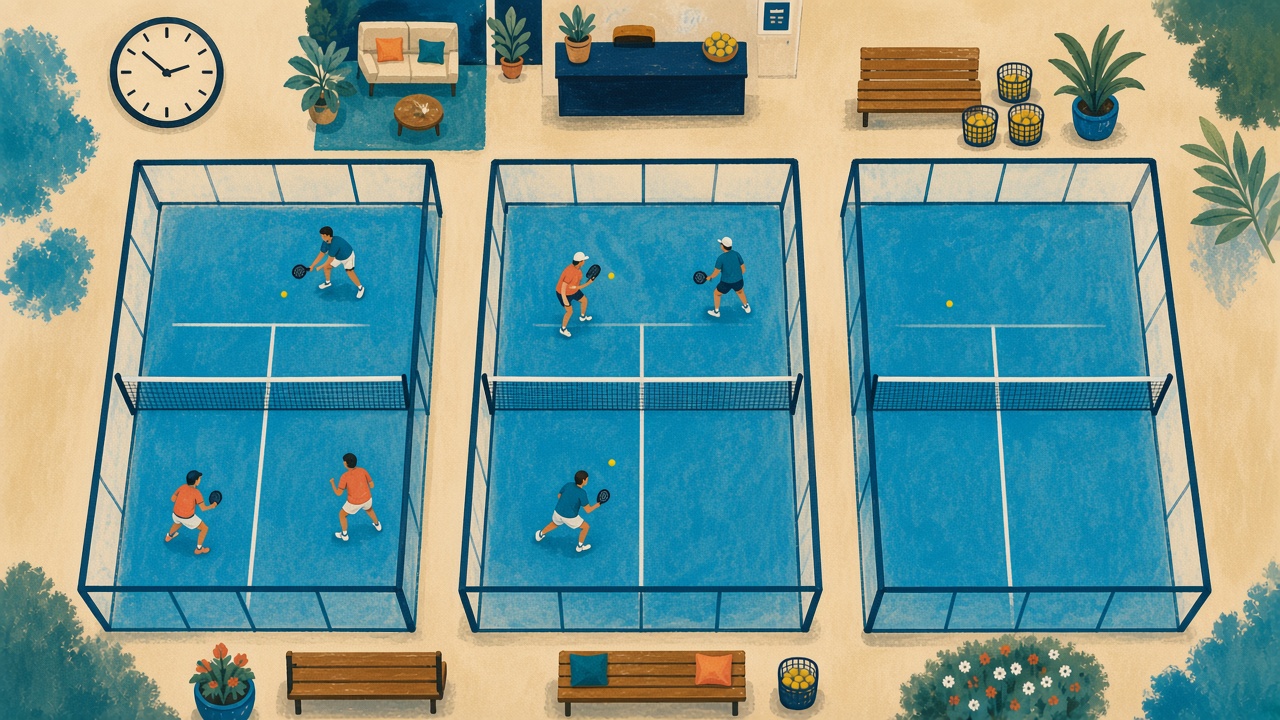
Court 3 is not spare capacity. It is the court that will run late, or the one you promised to a walk-in.
This is the napkin maths we now do before we post the flyer. Format first, then courts × hours, then the number of names you are allowed to accept. The other way around is how you host a beautiful draw that does not fit in the building.
We sketched a starter table in How to Organise a Padel Tournament. This post is the longer version: a formula you can reuse, and the friction that makes honest schedules look pessimistic until 11am, when they look kind.
One formula, then stop being clever
You are buying court-hours. Everything else is decoration.
Court-hours ≈ (matches × minutes per match) ÷ courts ÷ 60
Then add changeovers (about two minutes a match) and 30 minutes of human beings: briefing, late arrivals, the photo, the pair who cannot find court 2 because court 2 is behind a curtain.
If that number is bigger than the hours you booked, you do not have a tournament. You have a hope.
Minutes per match, said plainly:
| Scoring | Use it for | Minutes to budget |
|---|---|---|
| 16 rally points | Fast Americano, lots of people | 10 |
| 24 rally points | Default social | 14 |
| 32 rally points | Small group, they came to hit | 18 |
| Timed 12–15 min | Reception wants the court back | 15 + 2 change |
| One pro set | Tight club open | 30 |
| 2 sets + match TB | Proper Saturday | 50 |
Those are not coach-manual times. They include the ball that goes to another planet.
If the formula says 6.2 hours and you booked 5, do not “play a bit faster.” Cut rounds, cut the consolation, or cut names. Speed is not a policy. It is a wish.
Americano: the 4-player court
An Americano is honest about space. Four players fill one court. Eight need two if nobody sits. Sixteen on two courts is a queue.
| Players | Courts (nobody sits) | Rounds you can actually finish | 24-point night |
|---|---|---|---|
| 4 | 1 | 3 | 45–60 min |
| 8 | 2 | 6–7 | 90–120 min |
| 12 | 3 | 6–8 | 2–2.5 hours |
| 16 | 4, or two groups of 8 | 6–8 per group | 2–2.5 hours |
| 16 | 2 | Please do not | A sit-out with branding |
Worked: 8 players, 2 courts, 24 points, 7 rounds.
7 matches-per-court-stream × 14 minutes = 98 minutes. Plus 7 × 2 minutes of changing ends and finding the new partner = 14. Plus 15 minutes of “we’re almost ready.” You are at two hours. That matches the night people remember as “a quick Americano.”
Worked: 16 players, 2 courts, one field.
Only eight people play at a time. The other eight practise smash form against the glass and wonder why they paid. Split into two Americanos of eight, or find two more courts. We wrote the format rules in How to Run a Padel Americano. The clock is why.
One court per 8–10 players if you accept a sit-out. One court per four players if you want everyone hitting every round. Both are valid. Only the second one is comfortable. Tell people which you chose.
Complete rotations (everyone partners with everyone) get long after eight players. Twelve players, full rotation, is a lot of rounds. Most clubs play 6–8 rounds or stop at a points cutoff. Announce the stop. “We’ll see how it goes” is how you cancel someone’s dinner.
Club open: groups, then a bracket that actually ends
Fixed pairs. This is where hosts lie to themselves.
8 pairs, 2 groups of 4, 2 courts, 2 sets + match tie-break.
Each group plays 6 matches. That is 12 group matches. Two courts give you 6 group slots. 6 × 50 minutes = 5 hours before anyone plays a semi. Then a final. That is why the romantic “full sets, eight pairs, two courts” Saturday dies at the group stage.
What actually fits:
| Setup | Scoring | Group slots | Knockout | Honest day |
|---|---|---|---|---|
| 8 pairs, 2 courts | Pro set (~30 min) | 6 | SF + F | 4–4.5 hours |
| 8 pairs, 2 courts | 2 sets + MTB | 6 | SF + F | 6 hours, or you cut |
| 8 pairs, 3 courts | 2 sets + MTB | ~4 | SF + F | 4.5–5.5 hours |
| 16 pairs, 4 courts | Pro set | 6 | QF + SF + F | 5–6 hours |
| 16 pairs, 4 courts | 2 sets + MTB | 6 | QF + SF + F | 7 hours + photos |
| 16 pairs, 3 courts | 2 sets + MTB | more waiting | more waiting | 7+ hours. Book a fourth or shorten |
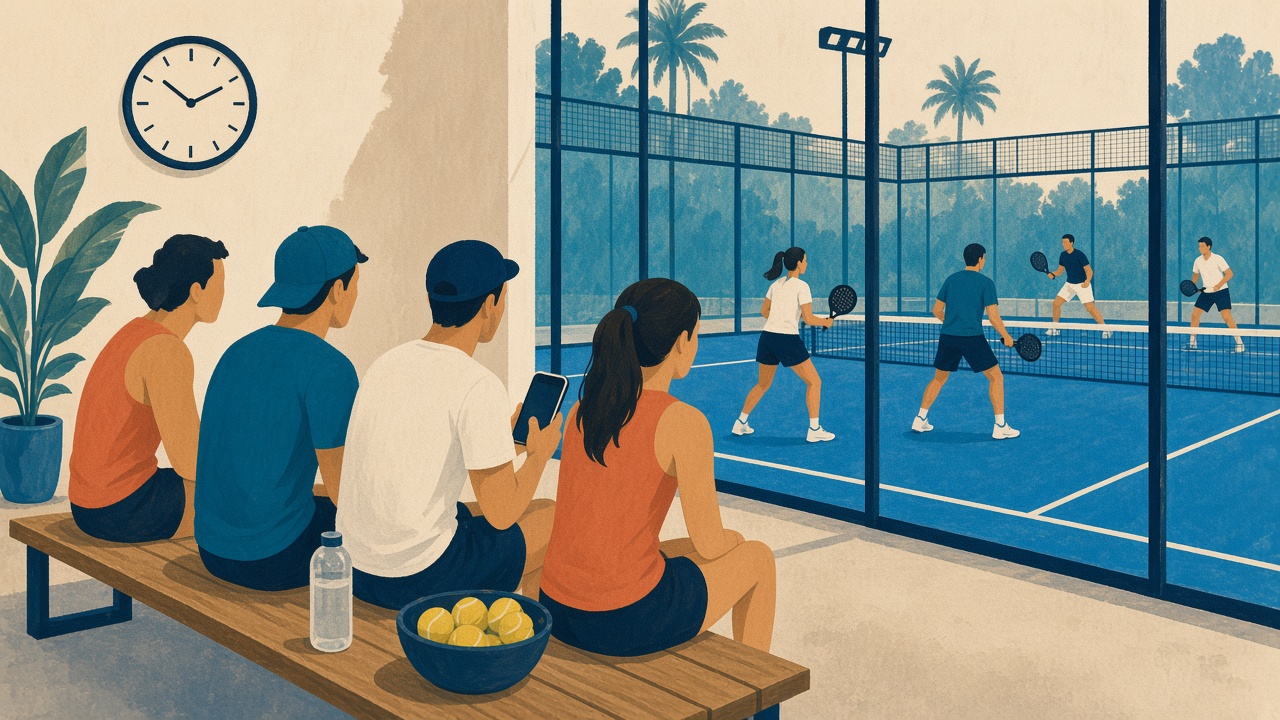
If the formula needs four courts and you have three, the missing court becomes a bench. Benches do not pay you back in goodwill.
Round robin of 10 pairs on 2 courts: every pair plays 9 matches. That is 45 matches. 45 ÷ 2 × 50 minutes ÷ 60 ≈ 19 hours. That is not a Saturday. That is a long weekend you will not get back. Keep full round robins to 6–8 pairs or shorter scoring. We said this in the round robin piece. The arithmetic has not improved.
Straight knockout is the time-saver people feel guilty about. 16 pairs, 4 courts, 50-minute matches: 8 + 4 + 2 + 1 = 15 matches. 15 ÷ 4 × 50 ÷ 60 ≈ 3 hours plus a final that you do not parallelise. Fine when everyone knew the deal. Mean if they paid for a full afternoon and lost at 10:20.
The 30 minutes you will not want to add
Add them anyway.
- Warm-up: 10 minutes if you let it exist. 25 if you do not time it.
- Briefing: 4 minutes if you practised. 12 if you explain deuce from first principles.
- Late pair: 5 minutes you actually enforce, or 20 you resent.
- Changeovers: two minutes, every time, even when “we’re staying on.”
- Prize photo: 8 minutes of people who cannot stand in a line.
Start on time. Waiting for the late pair punishes the people who were early. A five-minute forfeit warning you mean is ruder once and kinder all year.
Court assignment: publish it. If they have to find you to ask “3 or 4?”, the schedule is not public enough. A shareable link beats a man with a clipboard walking the corridor like a station master.
When the day is dying, cut the plan, not the truth
Have a shorter backup in your pocket before you need it.
Shorten scoring
Americano: 24 becomes 16, or a 12-minute cap. Open: third set was already a match TB. Next step is a pro set.
Cut consolation
The 5th-place draw is how you lose the final to the clock. Kill it first. People who are still in will not write you a poem about 7th place.
Split the field
Two smaller Americanos or two club-open draws. Parallel days feel smaller and finish. One giant draw feels important and leaks.
Stop adding names
The waitlist is not a suggestion box. Registration that respects the clock is in How to take padel tournament registrations.
Double-booking a court because “they’ll be done” is how you meet the 19:30 members in person. They will not be charmed by your trophy.
If you want the schedule to notice how many courts you have — not just how many names you collected — that is the job of a court-aware generator. Doing it by hand is how court 1 stares at the sky while court 3 hosts two matches in the same slot.
The draw should know how many courts you have
Padel Playground builds Americano, group, round robin, and knockout schedules across the courts you actually booked. Players follow the next match on a link. You stop being the person in the corridor with a clock and a theory.
How many courts for 16 players?
Americano: four if nobody sits, or two groups of eight on two courts each. Club open of 8 pairs: two courts is tight, three is humane, four is how you still have a voice at dinner. Sixteen pairs wants four courts or shorter scoring.
Can I run 16 pairs on three courts?
Yes, if you shorten the matches and accept a bench. Full 2-sets-and-a-tie-break on three courts is how the final starts when the lights are for the next booking. Add a court or lose a set.
What if it rains or a court dies?
Use the backup you already announced: timed rounds, pro sets, or cut the consolation. A backup announced at 9:00 is a plan. A backup announced at 15:40 is a panic with a microphone.