
Most padel tournaments do not fail because of the final. They fail at 11:14 the night before, when someone named Marco texts “can we start at 10:20 instead?” and you are still drawing matches on a napkin.
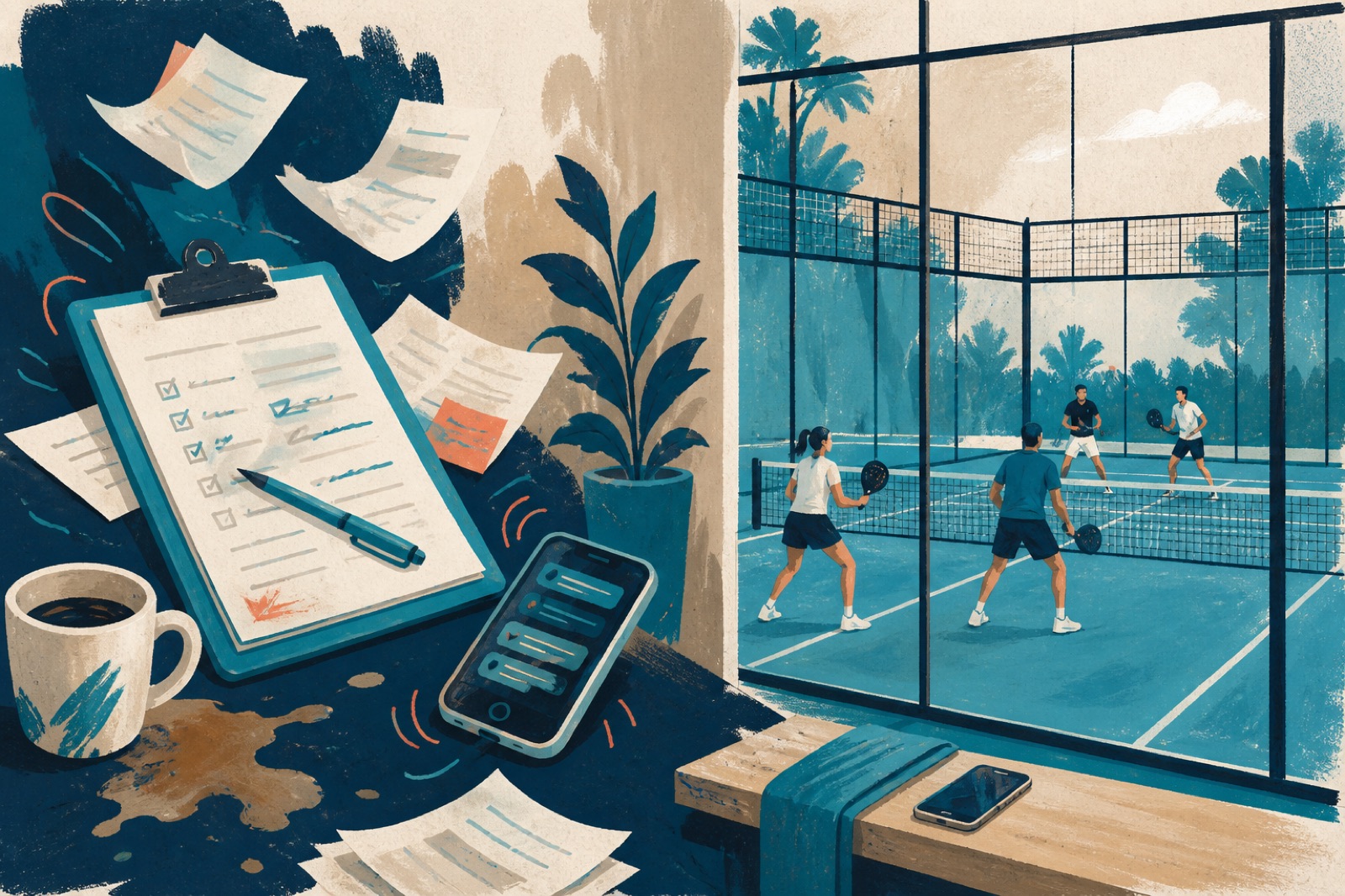
Left: Friday night. Right: what you promised the group chat.
This is the version we wish someone had handed us before the first club open. Not the romantic “just bring a trophy” version. The one with courts, late arrivals, and a pair that paid in cash then vanished.
The only four decisions that matter
If you get these right, the rest is housekeeping.
Write them down before you post the flyer. A tournament is just those four constraints wearing a medal.
If you cannot explain the format in one WhatsApp message, pick a simpler format. Players will not read your 900-word rules PDF. They will ask you on court one, while the next match waits.
Pick a format like a grown-up
The format is not a personality test. It is a time-and-fairness tool.
Americano
Partners rotate. Points are individual. Best for social nights and mixed levels. Needs groups of 4.
Round robin
Everyone plays everyone. Fairest table, longest day. Lovely for 6–10 pairs. Brutal for 20.
Group + knockout
The club-open default. Two or three guaranteed matches, then a bracket so the day actually ends.
Straight knockout
Fast, dramatic, slightly cruel. Fine when time is tight. Mean if someone’s first match is also their last.
If you want the longer “when to use which” version, we already wrote The Most Popular Padel Tournament Formats Explained, a separate round robin piece, and a full Americano guide. This post is about not losing the day.
Americano if you want people to meet. Group + knockout if you want a champion by dinner.
Courts, players, and the lie we tell about “a quick one”
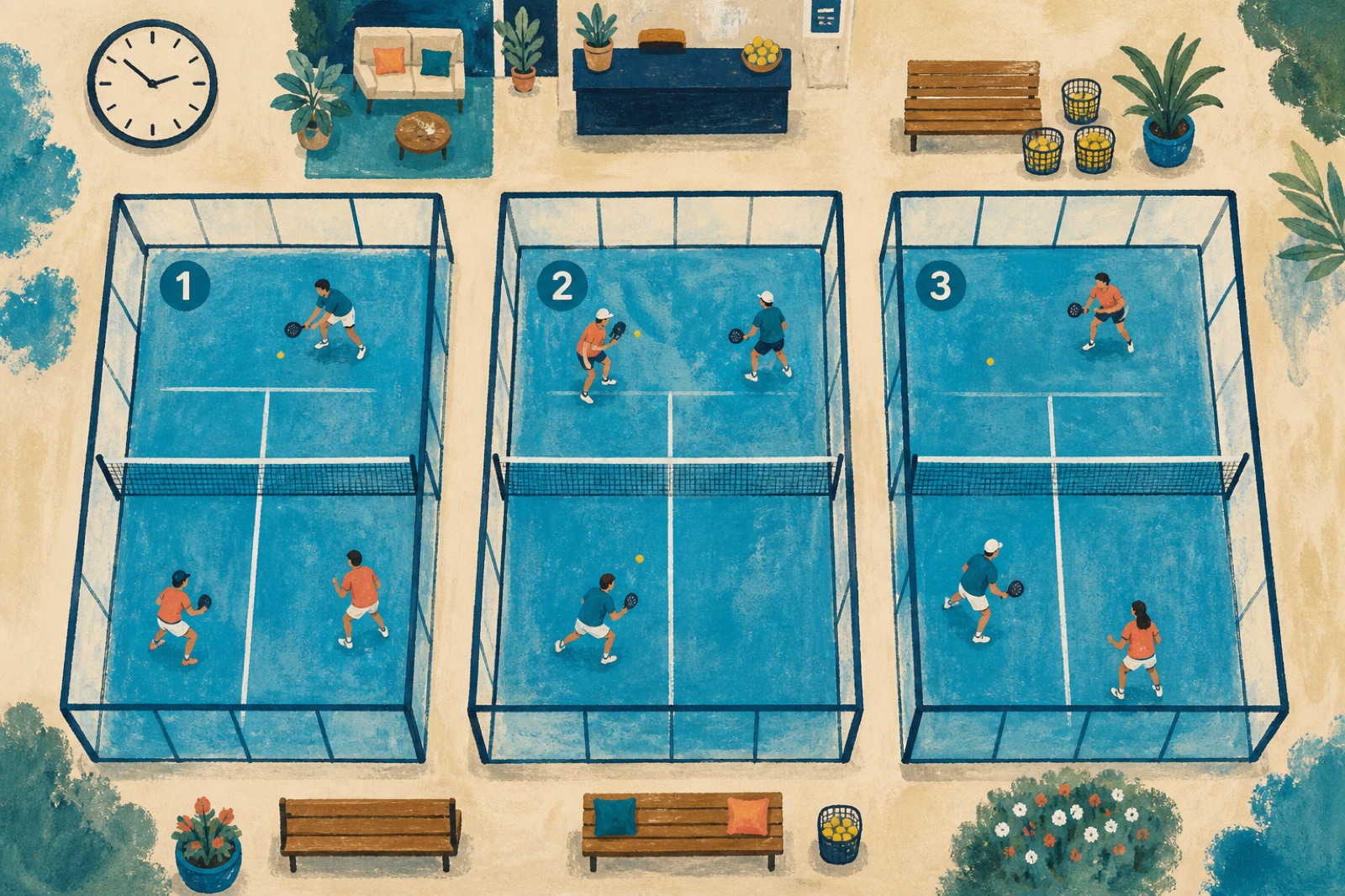
Three courts looks like a lot until sixteen pairs all want a warm-up.
A padel court eats time. Changeovers eat more. Someone’s “two-minute drink” is never two minutes.
Use this as a starting point, then add 30 minutes of human friction. The longer court-and-clock version is in How many courts and hours you need.
| Setup | Format | Match length | Realistic day |
|---|---|---|---|
| 8 players, 1 court | Americano, 16–24 pts | 12–18 min rounds | 90–120 min |
| 16 players, 2 courts | Americano | 15 min rounds | 2–2.5 hours |
| 8 pairs, 2 courts | Group + knockout | 2 sets + match TB | 4–5 hours |
| 16 pairs, 3–4 courts | Group + knockout | 2 sets + match TB | 6–7 hours |
For an Americano, budget one court per 8–10 players. Below that, people wait. Above that, you need a second group or a shorter scoring format.
Scoring that keeps a Saturday alive:
- Social: timed rounds (12–15 min) or first to 16 / 24 points
- Club open: two sets, match tie-break to 10 instead of a third set
- Golden point at deuce if you want games to end this year
Lock this before the first serve. Arguing about deuce in the semi is a special kind of ugly.
Registration without becoming a debt collector
Paper lists are how you accidentally enter “Alex” three times.
A clean entry flow looks like this. The longer registration-and-payments version is in How to take padel tournament registrations.
-
1
Open entries with a hard cap
Set a number of places that fits your courts. A waitlist is kinder than “maybe we can squeeze one more pair onto court 2.”
-
2
Take the fee when they register
Unpaid names are not entries. They are rumours. Paying up front is the cheapest no-show policy you will ever write.
-
3
Ask for a level and a partner
Beginner / intermediate / advanced is clumsy and still better than nothing. If someone is “intermediate everywhere except when trophies appear,” put them where the matches will actually be fun.
-
4
Close entries before you draw
Last-minute adds after the schedule is public create the exact chaos you were trying to escape.
Typical club fees we see: enough to cover court time, balls, and a bottle that looks like a trophy. In a lot of European clubs that lands around €10–€25 per player for a social or one-day open. Charge more only if you are actually giving more.
When one player drops, the remaining one should not have to hunt Instagram at 8am. Keep a short reserve list, or say in the rules that you will assign a substitute. Silence here is how you lose two people, not one.
Draws, seeding, and the “this group is cursed” feeling
Seed if you have any signal at all: club rating, last season’s table, or “we have watched these two destroy Tuesday nights.” Then split seeds across groups.
Do not put your four strongest pairs in Group A because they registered first. That is how you get a final that feels like a formality and a Group C that looks like a picnic.
For Americanos, the software should rotate partners. Doing this by hand is how you invent a new kind of headache.
Match day, minus the megaphone
Arrive early. Not “organiser early.” Actually early. Courts, balls, a printed backup of the first round in case someone’s phone dies. (Someone’s phone will die.)
Then run the day like this:
- Briefing, 4 minutes max. Format, scoring, where scores go, who to bother if a ball goes to another planet.
- First matches on time. Waiting for the late pair punishes the people who were on time. Start, or give them a 5-minute forfeit warning you actually mean.
- Scores in immediately. Standings that update later are standings nobody trusts.
- Tell people their next court. If they have to find you to ask “are we on 3 or 4?”, the schedule is not public enough.
“When do we play?” If the answer is not on their phone, it will be on your throat.
If you can, put live standings on a TV or a shared link. Players hover. Let them hover over a screen, not over you.
After the last point
Publish the table the same day. Thank people. Name the winners without a 12-slide speech.
Then, while you still remember the pain, write three notes: which format felt right, which court ran late, who you would seed differently. Next month-you will not remember. Next month-you is an optimist.
If the group asks “same thing in four weeks?”, you did it properly.
Want the draw to stop living in a spreadsheet?
Same desk for a social Americano and a proper club open: court-aware schedules, a web link to follow the draw and table, chat and availability in the app, pay in-app or outside. Bookings can live here later if you want one cheap modern stack. Today is about the tournament.
How many players do I need to start?
Four for a tiny Americano on one court. Eight pairs for a club open that feels like an event. If you are under six pairs, skip the trophy language and just play a round robin.
Do I need software?
For 8 friends and one court, a sheet can limp through. Past two courts, or any Americano with rotating partners, software stops being fancy and starts being how you keep friends.
What if it rains / a court dies / the neighbour’s dog eats a ball?
Have a shorter scoring backup in your pocket: timed rounds, one pro set, or cut the consolation bracket. Announce the backup before you need it, so it feels like a plan, not a panic.