
A tournament is a Saturday. A league is a rumour that becomes a habit. That is the good news. The bad news is habits die the first week the table is stale and two pairs “couldn’t find a time.”
If your league only exists in your head, it is not a league. It is a hope.
We have watched clubs launch a “proper season” in September and quietly bury it by November. Same players, same courts. The admin just got boring, then unfair, then ignored.
This is how to make one that is still alive in week 7.
Why bother, if tournaments are easier
Because a good league does three things a trophy night cannot:
- It gives intermediate players a reason to book Tuesday
- It creates a table people check on the toilet (this is engagement; do not fight it)
- It turns “the club” into “our season”
If your courts go quiet midweek, a league is not a nice-to-have. It is occupancy with gossip. Open matches and a recurring social sit next to that — we wrote How to fill empty midweek courts.
Players do not stay for your branding. They stay because they are two points off second and the other pair still has a match to play.
Two things that keep a league moving
Most leagues do not die on the rules. They die on admin nobody wants to do — chasing times in WhatsApp and chasing pairs who still owe a match.
Match completion stats nudge players for you
Publish a live table — and show who is behind. Match completion statistics per team: scheduled vs played, 0/4 completed, 4/4 still to go. Everyone sees who is dragging. That is social pressure that works without you sending another “friendly reminder” at 22:00.
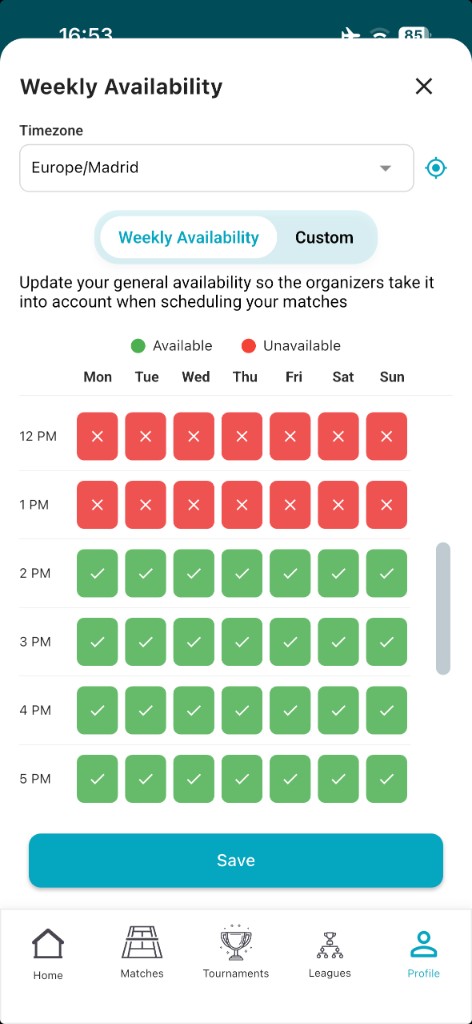
87 matches scheduled, zero completed yet — and every pair can see they are 0/4.
Player availability kills the group chat
The slow death of every league is the same thread: “Tuesday 19:30?” “Maybe, what about Thursday?” Multiply that by twelve pairs and you are the league’s unpaid secretary.
Let players set weekly availability once — green slots they can play, red slots they cannot. Organisers see it when they build the schedule. Pairs stop polling each other because the product already knows who is free.
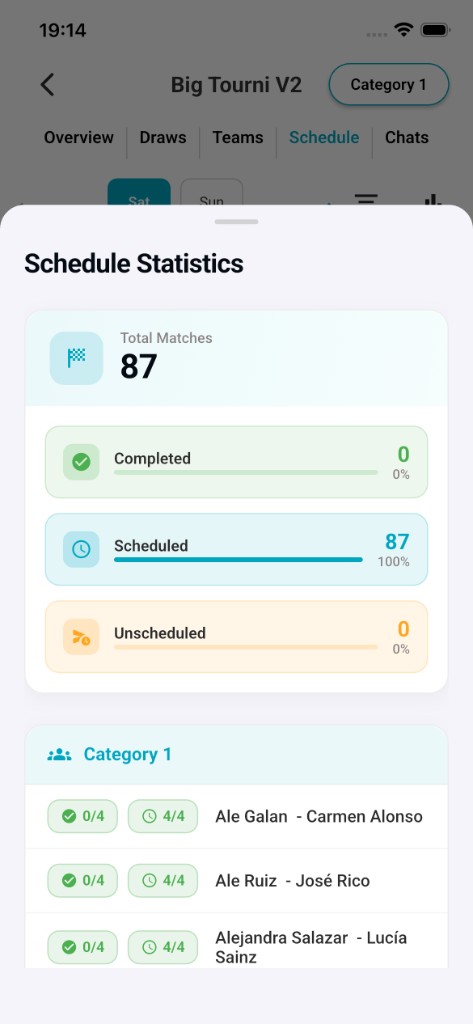
Set it once. Stop asking “are you free this time?” in three separate chats.
Pick a shape: box league or divisions
Do not invent a third animal on week one.
Box league
Boxes of 4–6 pairs. Everyone in the box plays everyone. Top goes up, bottom goes down. Best first league for 8–40 pairs. We are almost ready to roll this out in Padel Playground.
Division season
Bigger groups, a full table, promotion and relegation at the end. Better when you already know the levels and can fill 8+ pairs per division.
Start with boxes if this is your first season. They forgive missing data. They also give people a short, obvious to-do list: “play these three matches by 30 November.”
A division of 14 pairs with a full round robin is how you discover mathematics is not your friend.
Two boxes of four pairs. That is eight pairs and a real promotion story. Fewer than that, just run a round robin and call it a winter cup.
Scoring: boring on purpose
Fancy scoring makes you feel clever in the rules email. It makes the table look haunted.
Use one of these. Publish it. Do not “tweak it after week 2 because group B complained.”
| System | Points | What it does |
|---|---|---|
| Classic | Win 3, loss 0 | Simple. Punishes no-shows only if you add a rule. |
| Show-up | Win 3, loss 1, no-show 0 | Our favourite. Losing in person is still worth more than disappearing. |
| Close-match | Win 3, plus a bonus for a tie-break | Fun, slightly more admin. |
Tiebreakers, in this order, written before anyone plays:
- Points
- Head-to-head
- Set difference
- Game difference
If you are still tied after that, share the promotion or play a one-off. Coin flips make grown adults surprisingly spiritual.
A no-show should not protect your ranking. Award the match 6-0 6-0 or 2-0 in sets, and keep the “loss 0” for the ghost. Reliable pairs notice immediately if you go soft on this.
Match length: two sets and a match tie-break. It fits a 75–90 minute slot. Full best-of-three is how league night becomes “sorry, the 21:30 booking is staring at us.”
Do not schedule like a referee. Schedule like a parent.
Fixed dates sound professional. They also create forfeits.
The version that survives real jobs:
- Block league slots in the booking system so people are not fighting random walk-ins
- Give each fixture a window (10–14 days), not a single Tuesday
- One pair proposes two times. The other picks one. If they stall, the proposer gets the forfeit. Yes, really.
Availability in the app (see above) removes the friction before anyone picks a court. The two-week window and the forfeit rule still apply — you just stop being the middleman.

If the table is not on their phone, they will invent a table in the group chat. You will not like that table.
Standings should update when the score is entered. Not “when Alex has a minute on Sunday.” Players refresh. If the number is wrong, they stop believing the whole season.
Substitutes, dropouts, and the mid-season vanishing act
Someone will get injured. Someone will move cities. Someone will discover padel was a phase.
Write the substitute rule on day one:
- A pair may use one registered sub per match
- The sub cannot be a first-division ringer “helping out”
- If a pair withdraws, remaining matches are voids or awarded, and you say which
Silence here is how you get a tribunal in the WhatsApp admin chat.
The unsexy list that keeps a league alive
This is the whole sport, honestly.
-
1
Publish a live table
A screenshot from last Tuesday is not a table. It is folklore. Completion stats per team (see above) do the nudging for you.
-
2
Remind people in week one, then let the rules work
Chase once. After that, the forfeit rule does the talking. If you never enforce it, you trained people to ignore you.
-
3
Talk about the table in public
A two-line club story on Monday — “Box 2 is a knife fight, three pairs on 6 points” — does more than another rules reminder.
-
4
Open next season before this one ends
The last two weeks are when people are most addicted. That is when you take their money for spring, not in the quiet after the trophy photo.
Leagues that die
- Standings in a staff member’s head
- No-shows with no cost
- One huge division of mixed levels
- Fixtures that require a project manager
Leagues that last
- Public, automatic table
- A point for showing up
- Boxes that can promote
- A two-week window and a booked court pool
If you are moving off a spreadsheet, import the pairs and the points you already have. Starting from zero mid-winter is a good way to lose the room.
We built the league admin we got tired of doing by hand
Live standings, reward points, CSV import, chat on the division and on each match. Club mode (Squads) is live: players join a squad, so a club competes together. You can add another manager to that league, and a player can share a result as an image. Anyone can follow the table from a web link; availability, chat, and in-app join live in the app. Box leagues are almost ready to roll out. If you also want cheap modern bookings in the same place later, that is a club-plan aside. This bit is the season.
How long should a season be?
Six to eight weeks for a box league. Long enough for a story, short enough that a holiday does not wreck it. Full winter divisions can run 10–12 weeks if the windows are generous.
Fixed pairs or rotating partners?
Fixed pairs for a “real” league table. Rotating (Americano-style) for a social ladder. Do not mix the two in one standings list unless you enjoy explaining yourself.
How do I seed boxes?
Last season’s table if you have one. Otherwise self-rating plus a host who has eyes. When in doubt, put the loud confident pair one box lower than they asked. Matches will be better. Emails will be worse for one evening, then fine.